Mapping the Landscape of Semantic Drift Research
Coverage & Critical Gaps
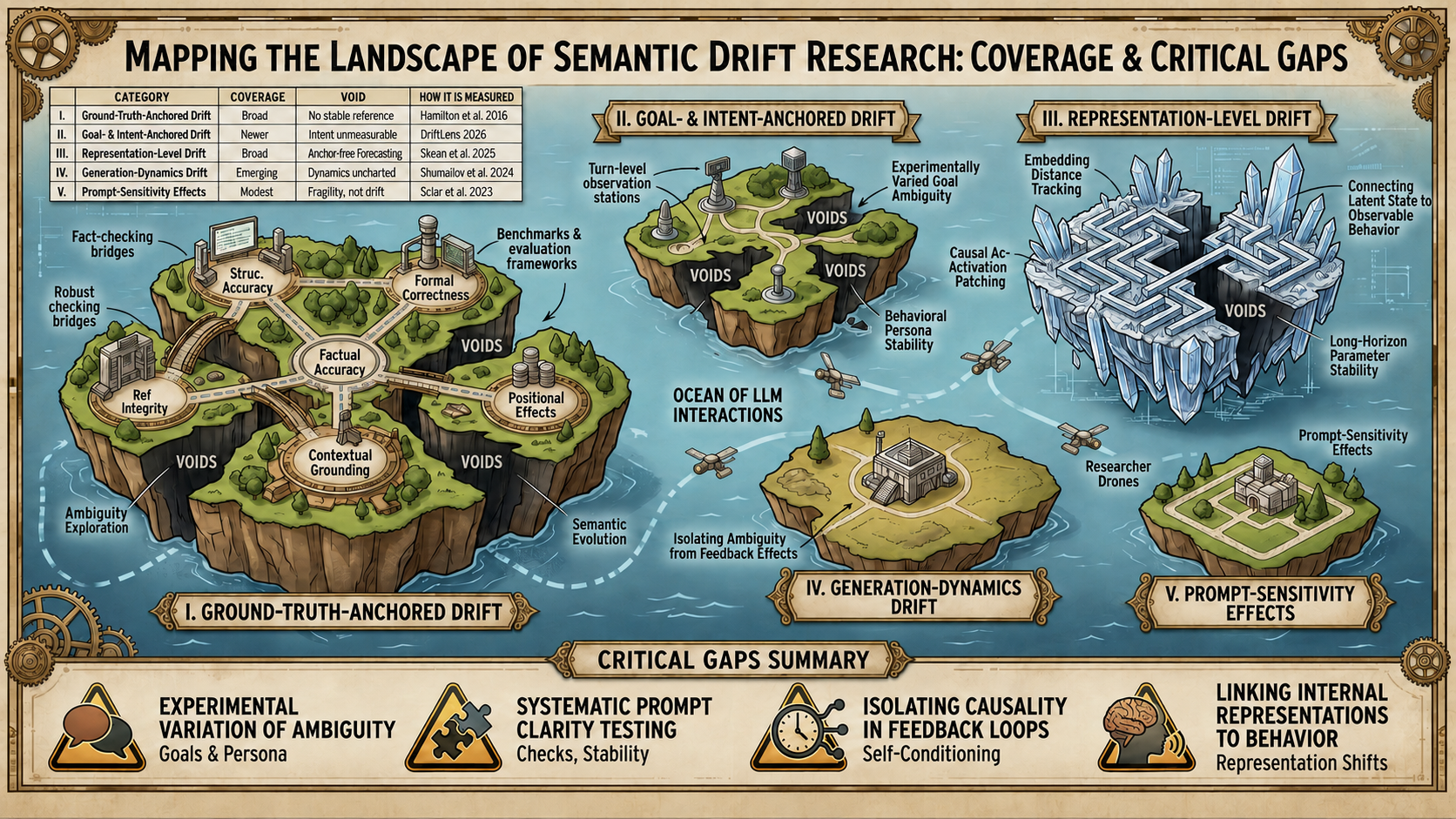
Semantic drift research is not a unified field but a loose archipelago of inquiries, each island representing a distinct category of drift phenomenon, with its own measurement traditions, theoretical framing, and characteristic voids. The map below surveys five such islands and the ocean of LLM interactions that connects and separates them.
Research Coverage at a Glance
| # | Category | Coverage | Critical Void | Measurement Reference |
|---|---|---|---|---|
| I | Ground-Truth-Anchored Drift | Broad | No stable reference | Hamilton et al. 2016 |
| II | Goal- & Intent-Anchored Drift | Newer | Intent unmeasurable | DriftLens 2026 |
| III | Representation-Level Drift | Broad | Anchor-free forecasting | Skean et al. 2025 |
| IV | Generation-Dynamics Drift | Emerging | Dynamics uncharted | Shumailov et al. 2024 |
| V | Prompt-Sensitivity Effects | Modest | Fragility, not drift | Sclar et al. 2023 |
The Five Islands of Drift Research
Each island represents a coherent research tradition with its own measurement apparatus, theoretical commitments, and characteristic blind spots. The voids are not accidental gaps but structural features of how each tradition has defined its own scope.
The oldest and most developed island. Research here measures how word meanings deviate from a stable reference — a ground-truth corpus, a fixed ontology, or a human-annotated benchmark. The tradition is rich in methods (distributional semantics, cosine drift, neighborhood shift) but structurally committed to the existence of a stable referent.
- Structural accuracy & formal correctness
- Factual accuracy & contextual grounding
- Referential integrity
- Positional effects
- Fact-checking & ambiguity exploration
No stable reference. When the ground-truth itself drifts — as in live clinical coding, evolving legal language, or recursive AI output — the anchor disappears and the measurement framework collapses.
A newer island concerned with whether AI output remains aligned with the user’s original intent across a conversation or task sequence. Drift here is measured not against a fixed corpus but against a target state inferred from behavioral signals — turn-level observations, goal ambiguity manipulation, persona stability tracking.
- Turn-level observation stations
- Experimentally varied goal ambiguity
- Behavioral persona stability
Intent is fundamentally unmeasurable without ground truth. The field lacks agreed methods for operationalizing user intent, making drift relative to it hard to distinguish from legitimate adaptation.
Broad and technically sophisticated, this island studies how internal model representations — embedding spaces, attention patterns, activation geometries — shift over time or across processing stages. The labyrinthine structure of internal representations makes connecting them to observable behavior a persistent challenge.
- Embedding distance tracking
- Causal activation patching
- Connecting latent state to observable behavior
- Long-horizon parameter stability
Anchor-free forecasting. The field can measure that representations drift but struggles to predict where they will drift to without a stable external anchor for calibration.
An emerging island studying how drift accumulates dynamically during the generation process itself — through recursive self-conditioning, feedback loops between model outputs and subsequent inputs, and the compounding of small distributional biases across inference steps.
- Isolating ambiguity from feedback effects
- Automated exploration via researcher agents
Generation dynamics remain largely uncharted. The causal structure of within-generation drift — how one token choice conditions subsequent drift trajectories — is poorly understood and rarely studied as a first-class phenomenon.
The most modestly developed island, studying how surface-level changes to prompts — wording, formatting, ordering, phrasing — produce large and unpredictable variation in model output. The central tension is whether this is a drift phenomenon or a distinct fragility phenomenon that merely resembles drift.
- Prompt-sensitivity effects quantification
- Systematic fragility mapping
Fragility, not drift. Current methods conflate sensitivity to surface variation (fragility) with meaningful semantic displacement (drift), limiting the theoretical progress of both traditions.
Critical Gaps Summary
The landscape reveals four structural gaps that cross island boundaries — voids that no single research tradition has the apparatus to address alone. These gaps define the frontier of semantic drift research and the most promising directions for novel contribution.
Experimental Variation of Ambiguity
No systematic experimental framework exists for varying goal ambiguity and persona consistency as independent factors in drift measurement. Current studies treat ambiguity as a confound rather than a variable of interest.
Systematic Prompt Clarity Testing
The field lacks a principled methodology for testing how prompt clarity interacts with semantic stability — distinguishing drift caused by representational shift from drift caused by input underspecification.
Isolating Causality in Feedback Loops
When model output is fed back as input, drift compounds in ways currently attributed only to the accumulated input distribution. The causal contribution of self-conditioning dynamics remains unidentified.
Linking Internal Representations to Behavior
Despite rich methods for tracking representational drift, the field has not established reliable bridges between internal geometric shifts in embedding space and observable changes in model behavior.
Implications for CMD Research
The Computational Meaning Dynamics Research Group’s work sits at the intersection of Islands I, III, and IV — ground-truth anchoring, representation-level tracking, and generation dynamics. Our geometric approach (Ollivier-Ricci curvature applied to embedding spaces) is specifically designed to address the void between representation-level measurement and behavioral prediction.
The critical gaps identified here map directly onto ongoing projects in the group. Gap 3 (causality in feedback loops) is the primary theoretical target of our dynamical systems framing. Gap 4 (linking representations to behavior) is the applied goal of the EchoCodes clinical surveillance framework.