CMD Research Approach
Deep research. Usable systems.
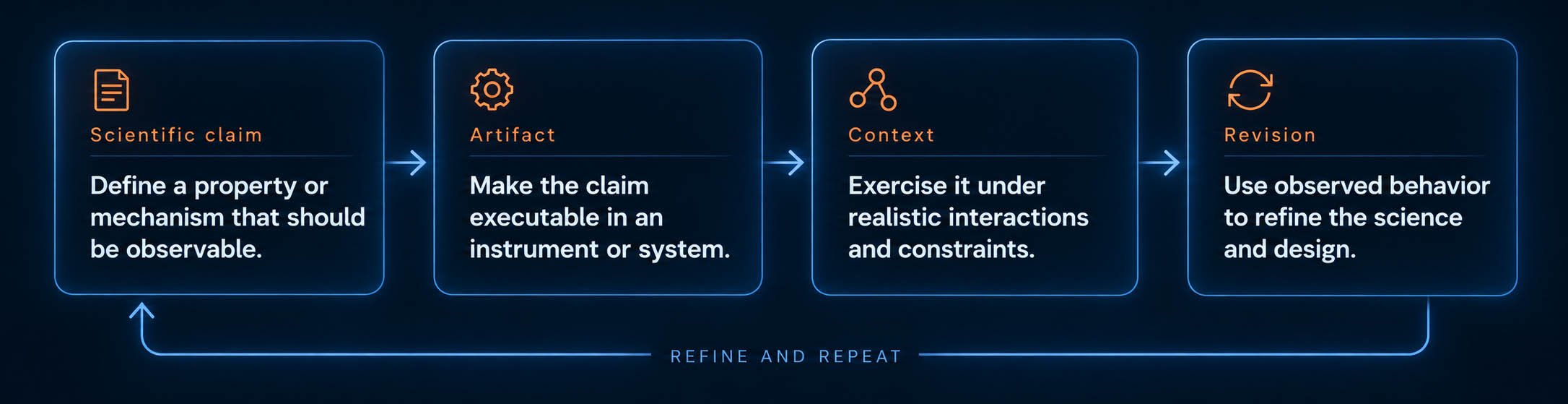
The Computational Meaning Dynamics Research Group takes a design science-centric approach to the study of CMD, drawing on and extending the foundational research we also conduct. Scientific questions drive the development of measurements and experiments; empirical findings shape new artifacts; and the behavior of those artifacts in context creates new scientific questions. Our results and deliverables are not limited to papers, nor do they follow a one-way progression from theory to application. Research and design inform and constrain one another. A useful measurement must survive empirical challenge, and a useful artifact must behave meaningfully beyond the laboratory conditions in which it was developed. We move iteratively between observation, measurement, experiment, intervention, and design to understand how meaning changes in-situ and to turn that understanding into capabilities that can actually be used.
A Research Cycle, Not a Pipeline
CMD research is iterative. Work may begin with an unexpected behavior in an AI system, a changing narrative, a longitudinal semantic pattern, or a practical problem that existing measurements cannot explain. Each stage creates evidence that can send the research backward, forward, or in a new direction.
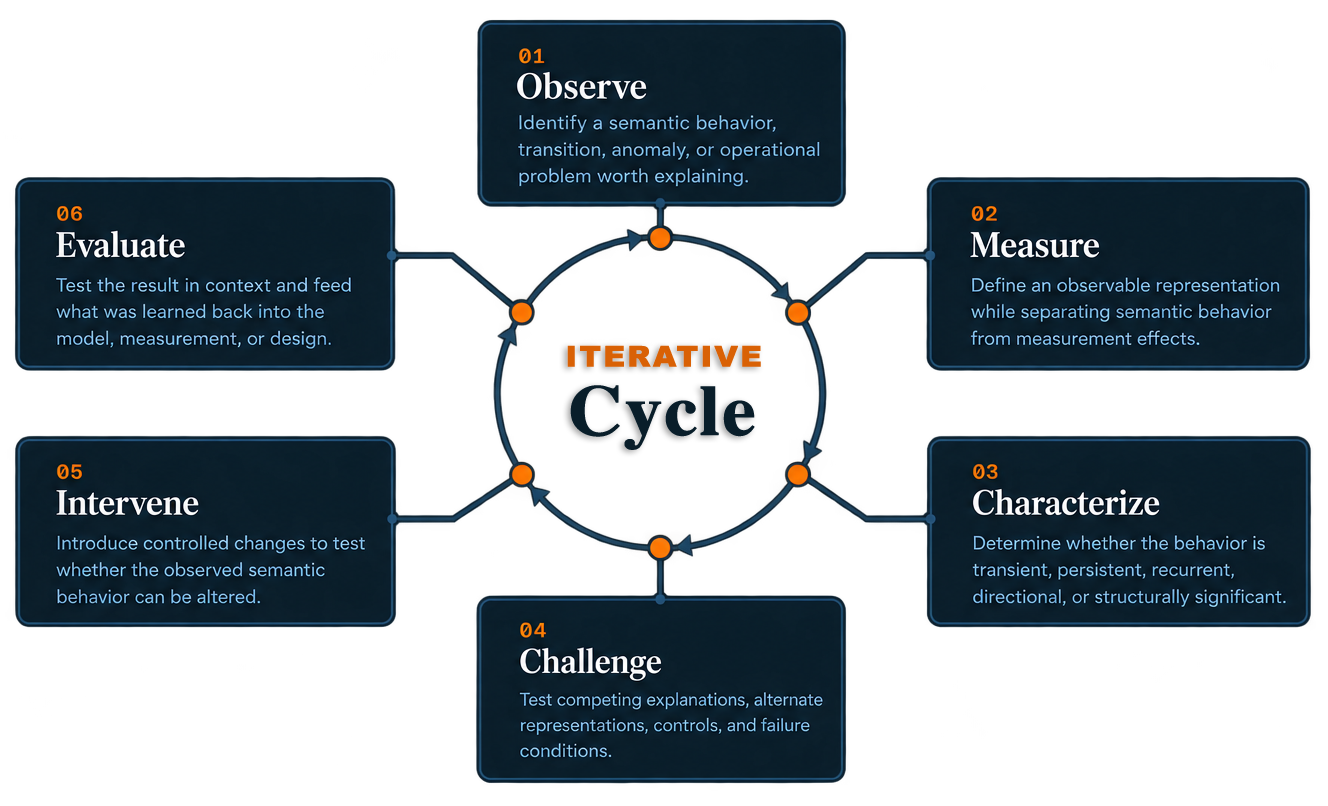
In multi-turn and recursive generation studies, we treat successive outputs as one evolving semantic trajectory rather than as independent responses. We then test whether meaning persists, reverses, recurs, or crosses into a different semantic regime.
Grounding, retrieval, context, and model changes can be introduced as controlled perturbations. We measure whether they simply change the next output or actually redirect the trajectory and produce a more stable semantic state.
Methods Follow the Question
CMD research is driven by the investigative question, rather than particular algorithms. Methods are chosen or developed to measure the property being studied and to make the distinctions the experiment requires. The specific instruments, combinations, calibration procedures, and decision rules depend on the experiment. New measures enter the CMD methodology as they are developed, tested, and validated through the research, allowing the methodological framework to evolve with the science.
| Method Family | Analytical Focus | What It Helps Distinguish | Example Research |
|---|---|---|---|
| Geometry | Local semantic structure, neighborhood organization, and directional movement | Coherent regions from transitional structure; displacement from reinterpretation |
SSDT, EchoCodes |
| Dynamics | Temporal dependence, persistence, recurrence, and trajectory behavior | Sustained change from correction, oscillation, fixation, and regime transition |
DriftWell, Meridian |
| Semantic Representation | Distributional change, semantic relationships, neighborhood change, and evolving frames | Consequential semantic change from surface variation, relabeling, or cosmetic movement |
DARMA, semPythia, VisualDrift |
| Causal + Experimental | Controlled perturbation, comparison, and intervention | Association from mechanism; whether grounding, retrieval, context, or system changes alter semantic behavior |
DriftWell, semPythia |
The Artifact is Part of the Experiment
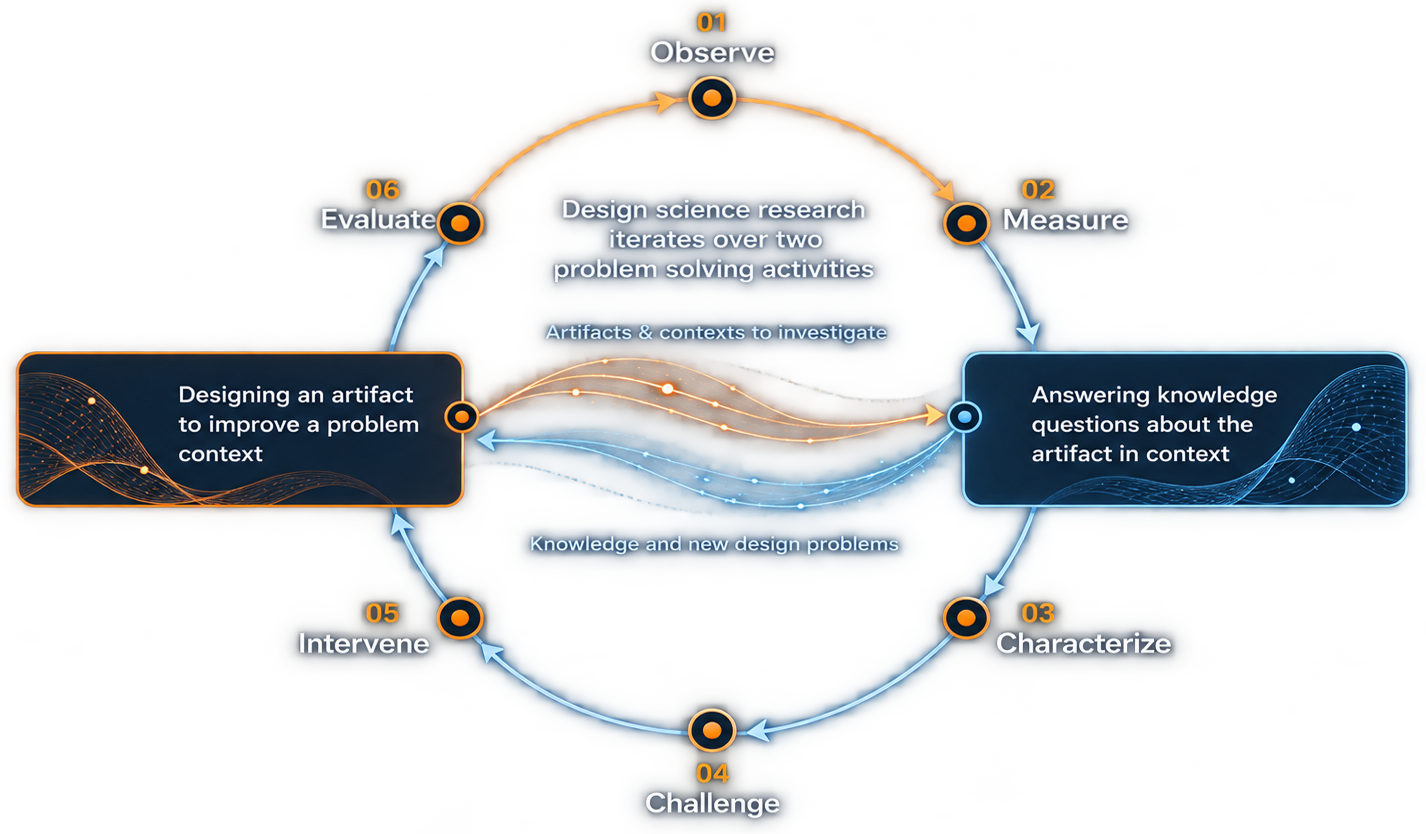
The pace of AI development and research is hyper-accelerated, compressing years of progress into months and reshaping what is technically, commercially, and socially possible at unprecedented speed. In the face of this, there is a need to better understand AI as an artifact; so, we adopt a Design Science approach to study computational meaning dynamics. In Design Science research an artifact is not simply an implementation produced after the research is finished. Building a measurement instrument, analytical environment, monitoring capability, or decision system makes scientific assumptions executable and exposes them to forms of evaluation that theory alone cannot provide. Once an artifact operates in context, interactions with data, people, workflows, other models, and changing environments can reveal assumptions, boundary conditions, and failure modes that were not visible in isolation. Those observations become new scientific evidence. Intervention is especially important in this process. Grounding, retrieval, context modification, model changes, routing, or human review can serve simultaneously as system improvements and controlled perturbations. The question is not merely whether the output changed, but how the semantic process changed, whether the effect persisted, and what that reveals about the mechanism involved.
Research That Becomes Usable
Some CMD research remains theoretical or experimental. Other lines mature into research systems that make the underlying science usable in broader settings. These systems are both outputs of the research and environments in which the research continues.
Meridian Observatory
A research platform for observing semantic movement as interactions unfold, allowing trajectories and transition behavior to be studied across turns rather than reconstructed only after an interaction is complete.
SemOSIris
A workbench for examining how interpretations and frames evolve across continuing real-world events, connecting semantic change to time, evidence, and event progression.
DARMA
A research framework that uses semantic change to direct attention toward changes in authoritative knowledge that are more likely to alter downstream AI behavior and therefore warrant revalidation.
TwinPath AI
An applied research architecture that connects semantic evaluation with longitudinal healthcare pathways, enabling alignment and governance where AI outputs are actually used in practice.
Our research approach is not theory without consequence or application without understanding. It is an investigative process in which explanation, measurement, experiment, and design continually test one another. Our measures of success are outcomes that advance our understanding of how meaning moves while also creating a usable capability to observe, test, or shape that movement.